Start with what is suspended in your water
Polyacrylamide (PAM) comes in three ionic types: cationic (positively charged), anionic (negatively charged) and nonionic (neutral). Picking the wrong charge is the single most common reason a polymer trial fails.
Before looking at molecular weight or product codes, ask one simple question: are the solids mostly organic or mostly mineral? Organic particles and biological flocs carry a strong negative surface charge, while inorganic mineral slurries rely more on long-chain physical bridging after pH or coagulant adjustment.
Cationic vs anionic vs nonionic side by side
| Cationic PAM | Anionic PAM | Nonionic PAM | |
|---|---|---|---|
| Charge | Positive (+) | Negative (−) | Neutral (0) |
| Best on | Organic sludge, biological, food & oily water | Mineral solids: sand, coal, tailings, iron fines | Acidic water, some dyeing & high-salt effluent |
| Typical pH | Neutral to slightly acidic/alkaline | Neutral to alkaline (pH ≥ 7) | Acidic to neutral |
| Standard | GB/T 31246 | GB/T 17514-2017 | GB/T 17514-2017 |
| Main role | Sludge dewatering & DAF flotation | Thickener rapid settling & water reuse | Acid-stable flocculation after PAC |
When cationic PAM wins
Choose cationic PAM whenever you are dewatering organic sludge on a belt press, screw press or centrifuge — including municipal sewage, food and slaughterhouse plants, and biological paper-mill sludge. Its positive charge neutralises negative organic surfaces and squeezes bound water out of the cake.
When anionic PAM wins
Choose anionic PAM for dense inorganic slurries: sand and coal washing, mining thickeners, steel scale pits and piling mud. High-molecular-weight anionic chains bridge heavy mineral grains into fast-settling flocs at very low doses.
If fine clay stays cloudy above the settled solids, add a small dose of industrial PAC before anionic PAM.
When nonionic PAM is the right call
In strongly acidic industrial streams, electroplating water or complex textile dyeing effluent, anionic chains coil up and lose bridging reach. Nonionic PAM stays extended at low pH and pairs well with PAC.
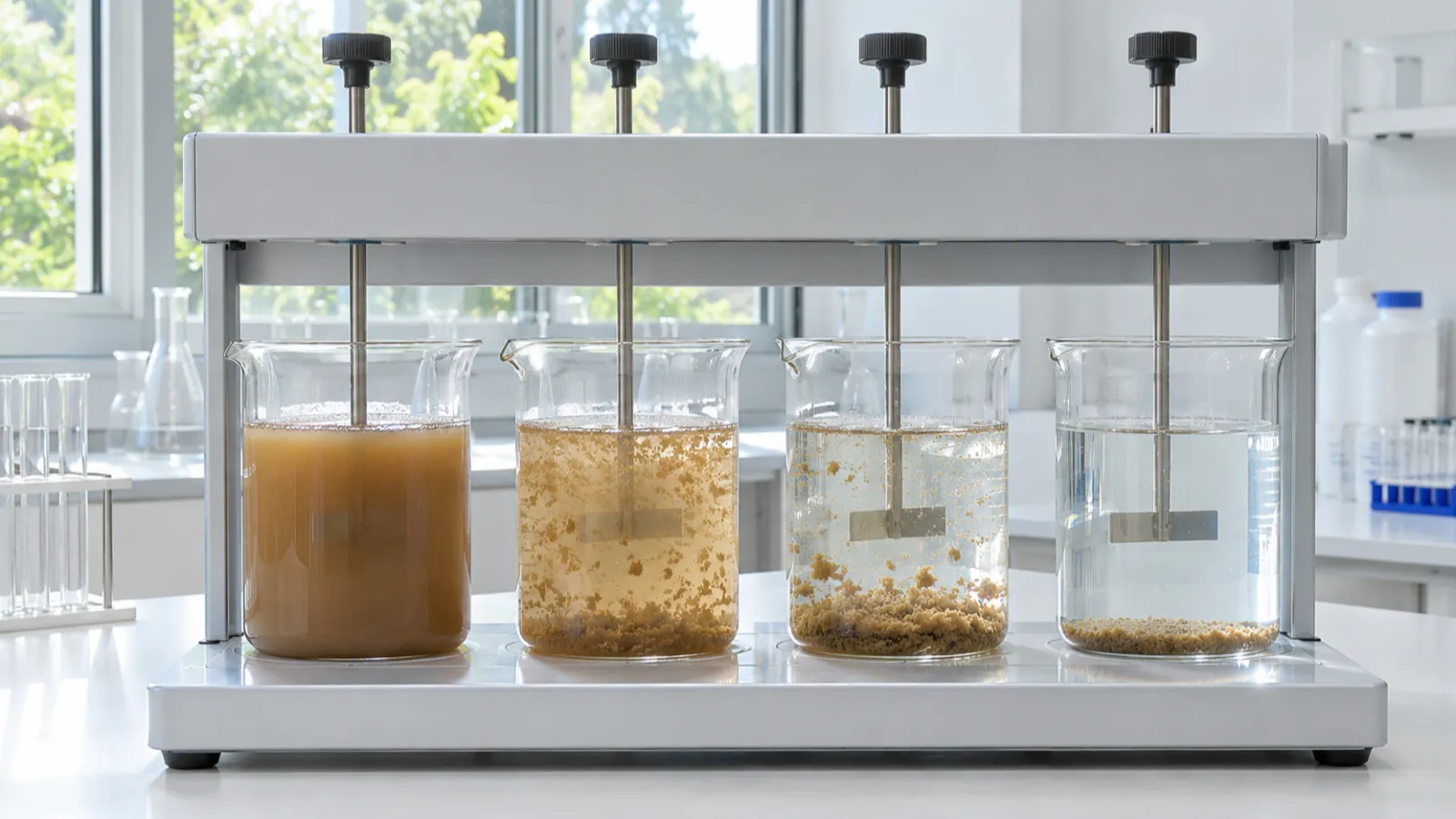
Send 1 litre of raw water or sludge. We test PAC and PAM combinations side by side and send a written report with grades, ratio and starting dose.
How it works →Common selection mistakes
Anionic PAM costs less per tonne than cationic PAM, but it will not dewater municipal biological sludge — using the wrong charge wastes 100% of the dose.
A grade that works on a gravity belt press can shear apart inside a high-speed centrifuge. Always match charge density and MW to your equipment.
Seasonal rain, pH swings or a new production line can shift the optimal charge density overnight.
FAQ
Short answers. For your own water, a jar test gives the real one.
Can I mix cationic and anionic PAM in the same make-down tank?
No. Opposite charges react immediately and form an insoluble gel that clogs pumps and pipes. Never blend them in one tank.
If I dose PAC first, which PAM should follow?
PAC works with all three types: pair with cationic PAM for organic/oily effluent and DAF, anionic PAM for mineral solids, and nonionic PAM for acidic or dyeing water.
What if my wastewater has both organic and mineral solids?
Mixed industrial streams need a 30-minute jar test comparing cationic, anionic and nonionic side by side on your actual sample.
How do I get the right charge density or molecular weight?
Send 1 litre of your water or sludge for a free jar test — we test several grades in parallel and send a written recommendation.
 Checklist
 Guide
 Guide