Two levers on every PAM chain
Once you have chosen the ionic type (cationic, anionic or nonionic), two properties decide how a polyacrylamide grade behaves in your plant: molecular weight (MW) and charge density.
| Property | What it is | What raising it changes |
|---|---|---|
| Molecular weight | Length of the polymer chain | Larger flocs, faster settling in thickeners, higher solution viscosity, longer dissolution time |
| Charge density | Percentage of charged monomers on the chain | Stronger electrostatic binding to organic solids, tighter shear resistance, higher price per tonne (CPAM) |
How molecular weight works in practice
In sand washing and mining thickeners, heavy mineral grains need a long polymer chain to reach across gaps and pull particles together quickly — that is why high-MW anionic PAM is standard.
In sludge presses, however, ultra-high MW can make flocs overly slimy and slow to drain. Medium-to-high MW often produces a drier cake and cleaner filtrate.
How charge density works in practice
Organic sludges (municipal, food, paper) carry strong negative charge. Low-charge cationic PAM suits thickening and light fibrous sludges; medium charge suits belt and screw presses; high charge suits digested sludge and high-shear centrifuges.
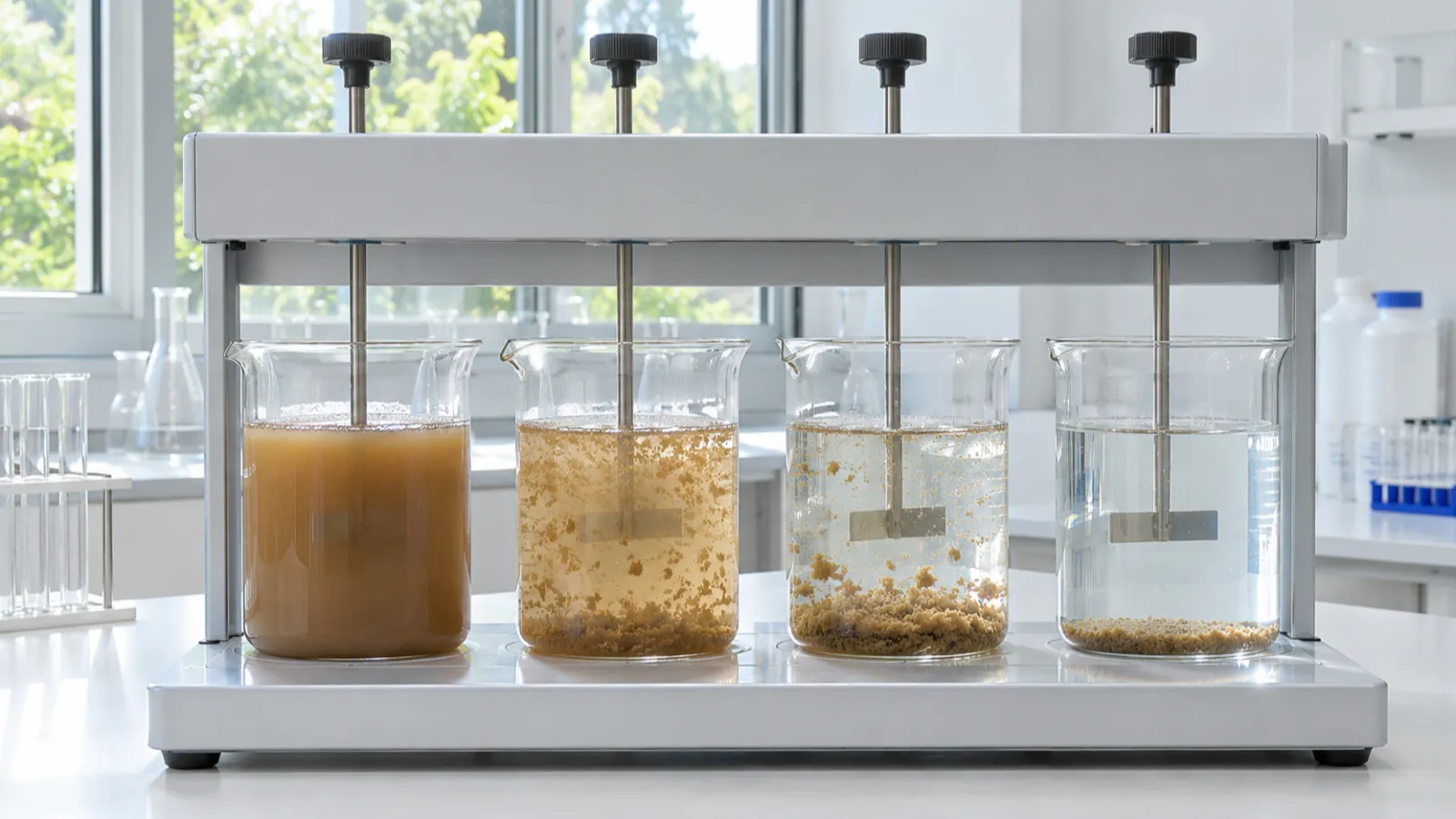
Send 1 litre of raw water or sludge. We test PAC and PAM grades side by side and send a written report with grades, ratio and starting dose.
How it works →FAQ
Short answers. For your own water, a jar test gives the real one.
Why does higher-charge cationic PAM cost more per tonne?
Cationic monomer is the most expensive raw material in CPAM, so higher charge density raises manufacturing cost. A jar test avoids over-buying charge you do not need.
Can I judge molecular weight from powder appearance?
No. Low, medium and high MW granules look identical to the eye — check the COA or run a viscosity / jar test.
What if my centrifuge cake is still wet with medium-charge CPAM?
Step up to a higher charge density grade in a sludge jar test, or check if your PAM solution is under-dissolved.
 Checklist
 Guide
 Guide