What you need before starting
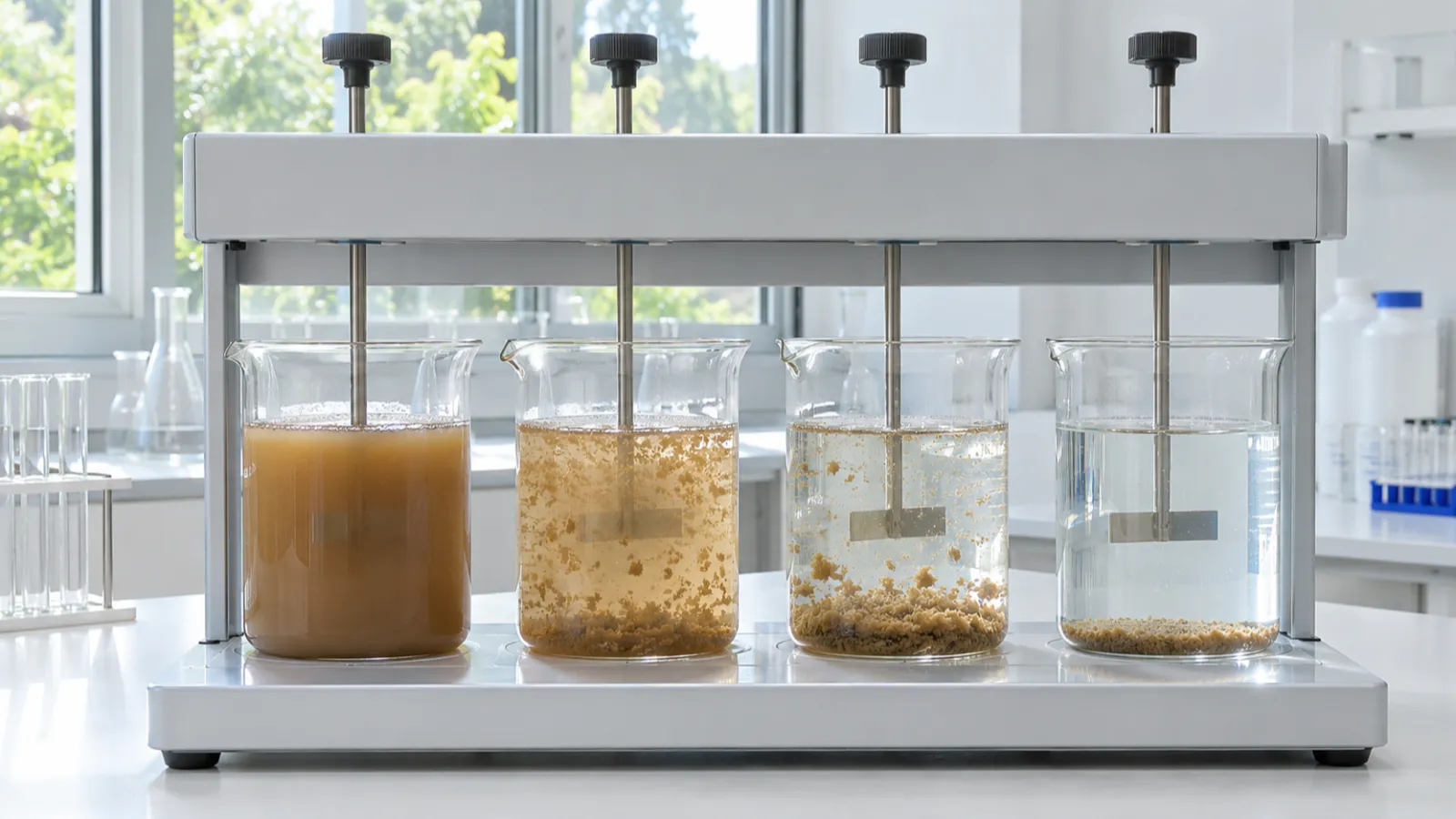
You do not need an expensive lab to run a useful jar test. A 4- or 6-paddle jar tester gives the cleanest repeat, but even clear 500 mL or 1000 mL beakers with syringes and a timer work well.
| Item | Recommended setup |
|---|---|
| Beakers | 4 to 6 identical 500 mL or 1000 mL clear glass beakers |
| PAC stock solution | 1% w/v (10 g PAC powder dissolved in 1 L clean water; 1 mL = 10 mg PAC) |
| PAM stock solution | 0.1% w/v (1 g PAM dissolved slowly in 1 L clean water; 1 mL = 1 mg PAM) |
| Dosing tools | 1 mL and 5 mL graduated syringes (separate syringes for PAC and PAM) |
| Sample | Fresh, well-mixed raw water or sludge collected the same day |
Step-by-step 30-minute procedure
- 1Measure baseline & fill beakers
Record raw water pH and appearance. Mix the sample bucket well and pour 500 mL (or 1000 mL) into each beaker.
- 2Dose a PAC ladder (rapid mix)
Start rapid mixing at 200–300 rpm. Add increasing PAC doses across beakers (for example 20, 40, 60, 80, 100 mg/L) and mix for 60 seconds so charge neutralisation finishes.
- 3Slow down and add PAM
Drop stirrer speed to 40–60 rpm. Dose a fixed starting PAM amount (e.g. 1–2 mg/L) into each beaker and stir gently for 2–3 minutes so flocs grow without shearing.
- 4Stop mixing and time the settling
Lift the paddles cleanly and start a timer. Watch how fast the floc interface drops at 1, 3, 5 and 10 minutes.
- 5Lock PAC, then tune PAM
Pick the clearest PAC dose, then run a second 10-minute round holding PAC constant while varying PAM type or dose (e.g. 0.5, 1, 2, 3 mg/L).
What to look for in the winning beaker
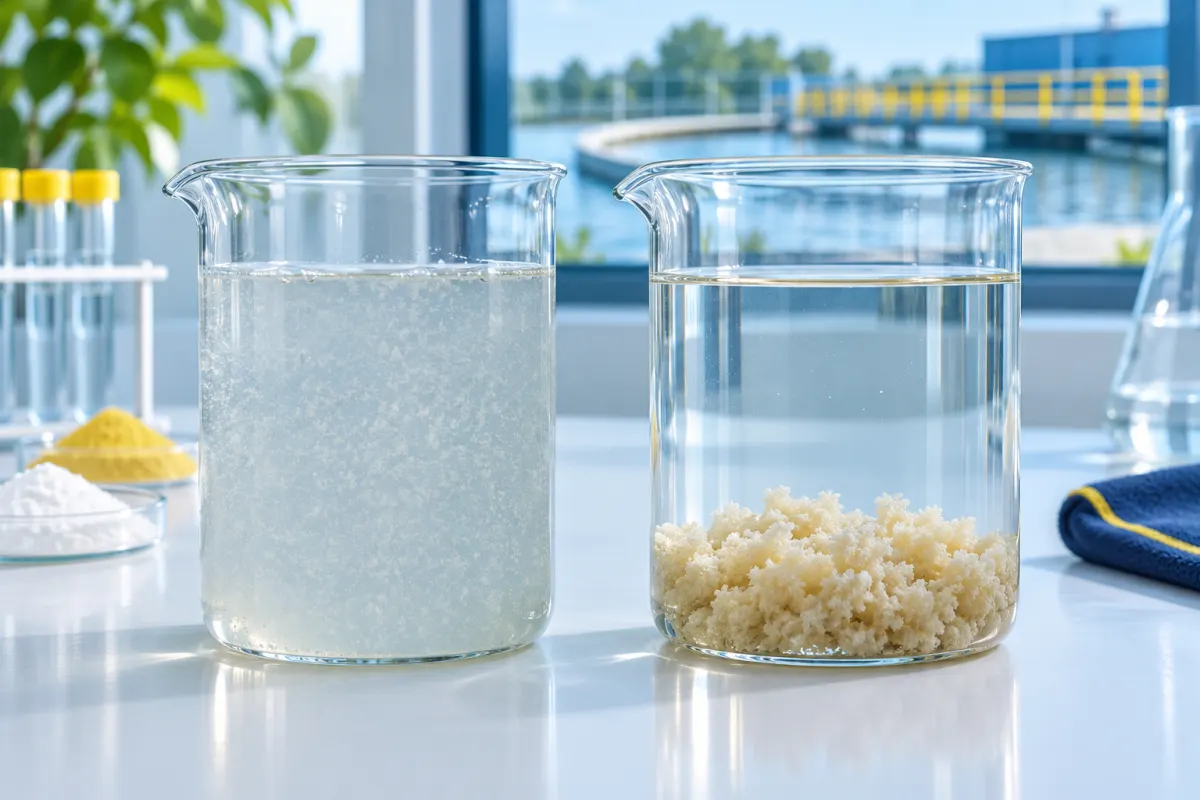
Record four simple observations for every beaker: floc size (pin floc vs firm marble-like floc), settling time, supernatant clarity (look horizontally through the upper liquid against white paper), and sludge volume at the bottom. If a higher dose makes the water cloudier again, you have passed the charge-neutralisation window and overdosed.
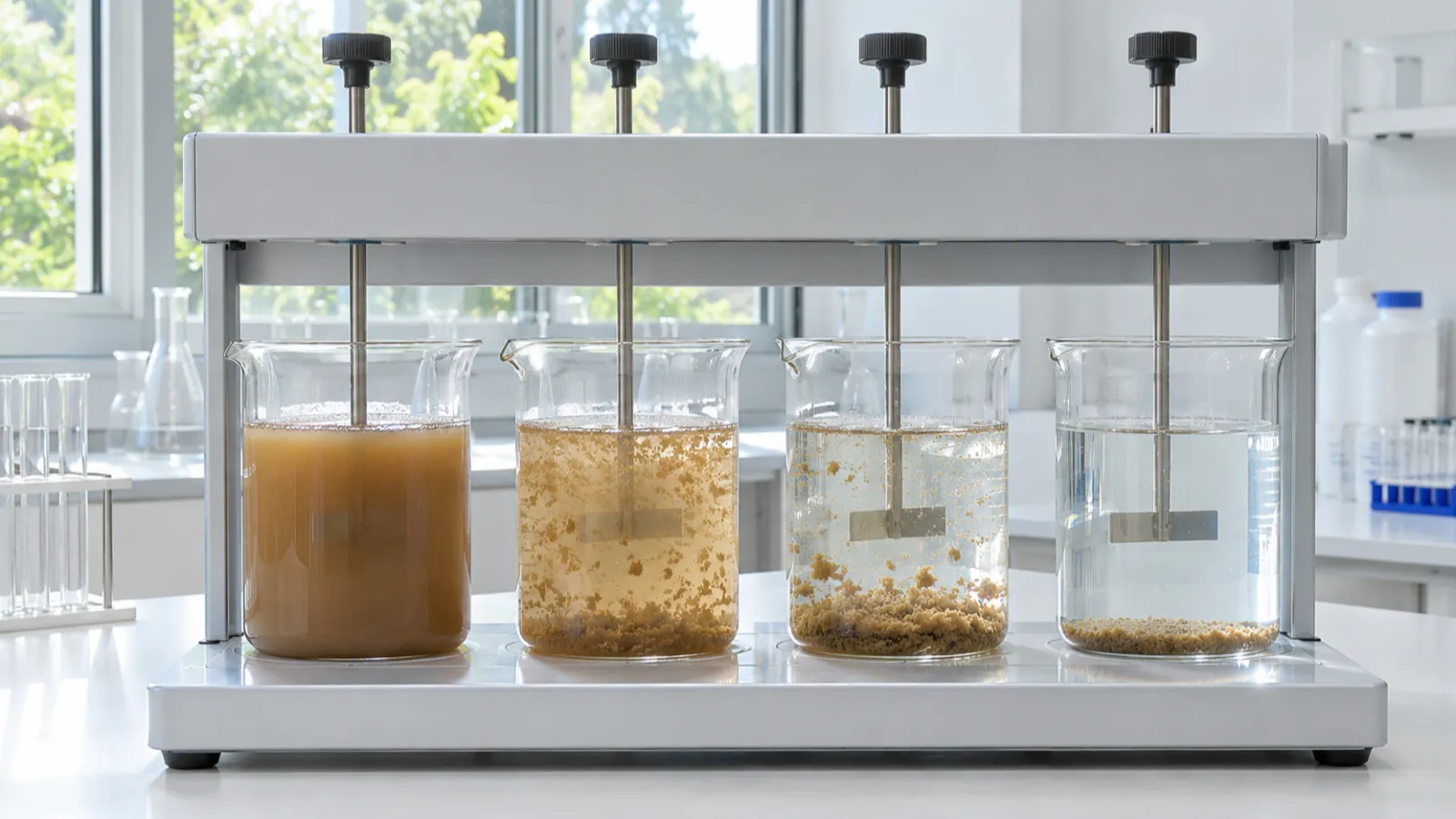
Send 1 litre of raw water or sludge. We test PAC and PAM combinations side by side and send a written report with grades, ratio and starting dose.
How it works →Common jar-test mistakes
Dilute 0.1% PAM loses viscosity after 24–48 hours, making a good polymer look weak. Always mix fresh stock on test day.
PAC must neutralise particle charge first. Always give PAC 30–60 seconds of rapid mix before adding PAM.
High-speed mixing after flocculation shreds polymer bridges — flocs will not reform cleanly once broken.
FAQ
Short answers. For your own water, a jar test gives the real one.
How do I convert jar-test mL into plant kg/day?
With a 1% PAC stock in a 1 L beaker, 1 mL equals 10 mg/L (10 g/m³). Multiply g/m³ by your plant flow (m³/h) and running hours, then divide by 1000 — or use the free calculator on our Guides page.
Can I run a jar test on thick sludge for dewatering?
Yes. Use 200–300 mL of sludge, dose 0.1% cationic PAM in steps, pour onto a small mesh sieve and compare free-drainage speed and filtrate clarity.
Will Claripoly run the jar test for us?
Yes, free of charge. Send 1 L of water or sludge; we test multiple PAC and PAM grades side by side and send a written report.
 Checklist
 Guide
 Guide